Windows to the Past: Exhibiting the Story of Melbourne’s International House

Windows to the Past is a new project aimed at celebrating some of the historically significant buildings at Melbourne’s International House (IH). The project will create permanent exhibits at IH focussed on its three earliest purpose-built accommodation buildings: Clunies, Wadham, and Scheps. The exhibits will comprise photographs, illustrations, and building plans from the International House Collection and the University of Melbourne Archives.
Clunies

The Ian Clunies Ross Wing (completed 1956; named 1963) was designed by eminent Melbourne architects Ray Berg (1913–1988) and Hubert Waugh (1901–1969), with Leighton Irwin and Co. as the supervising architects (“International House, Hostel for Asian Students,” 1956). The first purpose-built accommodation building at Australia’s first ‘International House’, it retains ‘a high level of integrity to its original design’ (GML Heritage, 2023, vol. 4, p. 372).
Wadham

The Samuel Wadham Wing (1963) was IH’s second purpose-built accommodation wing, designed in the Modernist style by Mockridge, Stahle & Mitchell. The building represented a considerable improvement to student accommodation at IH. As well as bedrooms, it included a library, tutorial rooms, a gym, common rooms, a music room, staff offices and the formal entry to IH (Larkins, 2018, p. 50). At Wadham’s official opening on 23 March 1963, Richard Casey described the building as ‘a microcosm of the world in which young people of many countries live, work and play together… They may be termed opinion-formers and can do much to help break down misunderstanding and social barriers between Australia and her overseas neighbours’ (“New Student Quarters Opened,” 1963).
Scheps
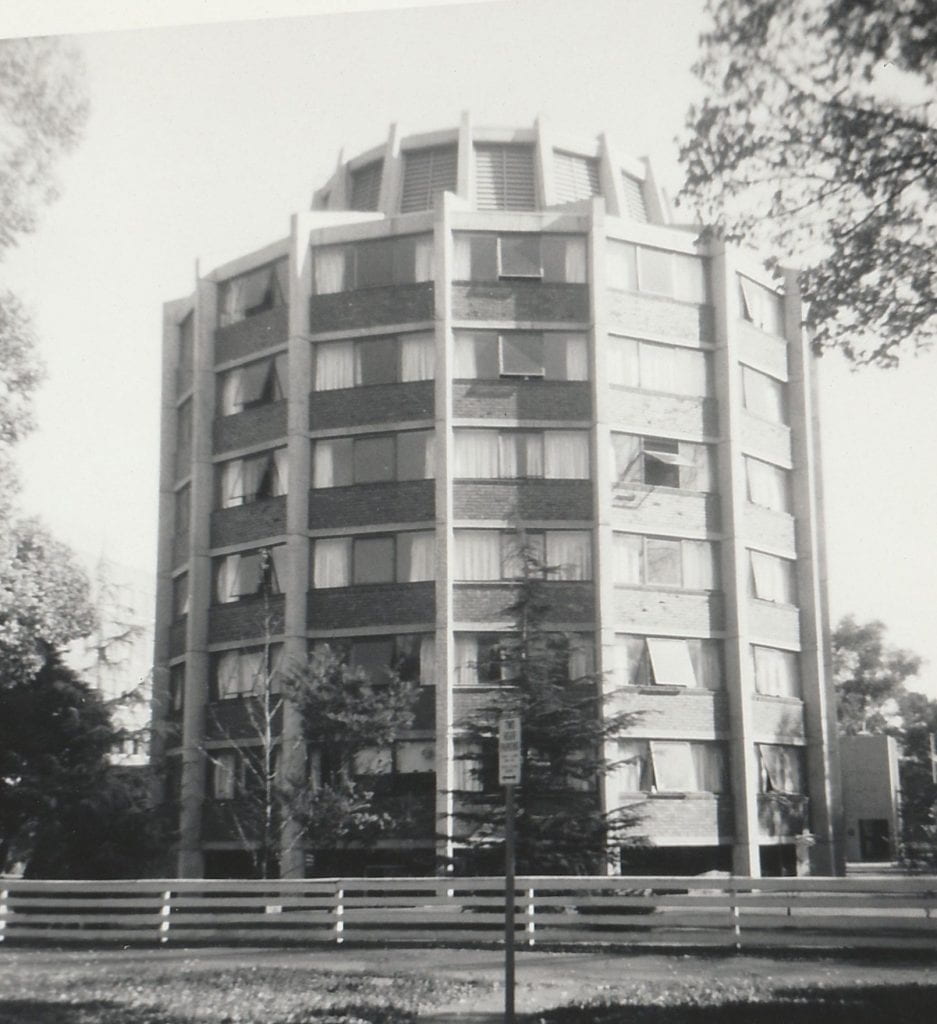
The ‘sixteen-sided Modernist tower’ (GML Heritage, 2023, vol. 4, p. 381) of the Scheps Wing (1972) has been a prominent landmark on Parkville’s Royal Parade for more than fifty years. Its opening coincided with the admission of IH’s first female residents, making IH the University of Melbourne’s first coeducational college (Larkins, 2018, p. 79).
We would love to hear from any former residents with photographs of these buildings (especially interiors) that they would be willing to donate to the International House Collection.
Contact the project team: ih-library@unimelb.edu.au
Windows to the Past is supported by the Russell and Mab Grimwade Fund at the University of Melbourne.
References
GML Heritage (2023, July). Parkville heritage review: Report prepared for the City of Melbourne: Volume 4.
Citations. https://www.melbourne.vic.gov.au/meeting/future-melbourne-committee-14-november-2023
International House, hostel for Asian students… (1956, November). Cross-Section, University of Melbourne Department of Architecture, [2].
Larkins, F. (2018). International House Melbourne: Sixty years of fraternitas, 1957–2016. Melbourne University Publishing.
New student quarters opened (1963, March 25). The Age, 4.