Fighting as a Family and the Upward Reach of an Underdog
George Fforde
Among hundreds of images in the ‘Records of Stadiums Pty Ltd’ collection, many of them promotional mug shots which rarely show the same boxer more than twice, can be found an atypically extensive set of seven photographs depicting, of all things, a family. Their presence offers a counterpoint of tenderness amidst the hundreds of combative postures.

These are ‘The Three Cooks’: Mr and Mrs George Cook and their young daughter. Mrs Cook’s given name is not attached to any of the photos (even when she is the sole subject) and their child is variously named as Julia or Julie. Nor are there any dates or related metadata for the photos. Digitised press records available through Trove and other newspaper collections help provide some background to the otherwise sparse information on this family.

The 24-year-old George arrived in London to ‘an elaborate gymnasium’ where he would train in front of spectators. Cook was reported to frequent West End dance halls directly after his matches. It was at one of these he met Emily Rides: a widow four years his senior to whom he was married in July 1922. The couple’s daughter Julia was born later that year. Based mainly out of the UK (but frequently returning to Australia) from that point in his life onwards, George Cook’s success as an international boxer was ambivalent but not insubstantial. Of his prominent fights, he lost more than he won and missed four times the coveted ‘Empire Championship’. He nonetheless succeeded in making a remarkably long career from being consistently matched with world-famous fighters regularly considered to be out of his class, and whose legacies in boxing history have outlived his. This practice, and his willingness to travel frequently and far afield as an underdog ‘challenger’ secured him not only a good income but wide popular admiration for pluck and grit.


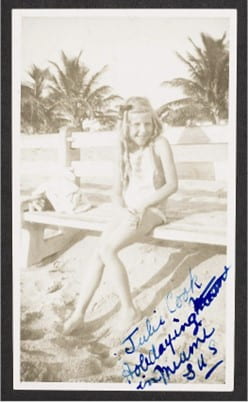
As a family, ‘the Three Cooks’ were collectively represented in accounts of George’s dogged international touring. Photos of Julia in the sporting press described her as a ‘much-travelled child’, and the positive example of Emily was often brought up in debates in the sporting papers over the influence of marriage on boxers. After over a decade of attending all his fights and travelling ‘three times around the world’, Emily made UK history in 1933 as the first woman to secure an official license as George’s trainer and manager (though she was denied permission to act as a Second). Up to this point George had had a series of official managers (one of whom sued him for breach of contract), but Emily was described by George as “a wonderful pal and a great judge of boxing… I should be lost without Emmie in my corner”.
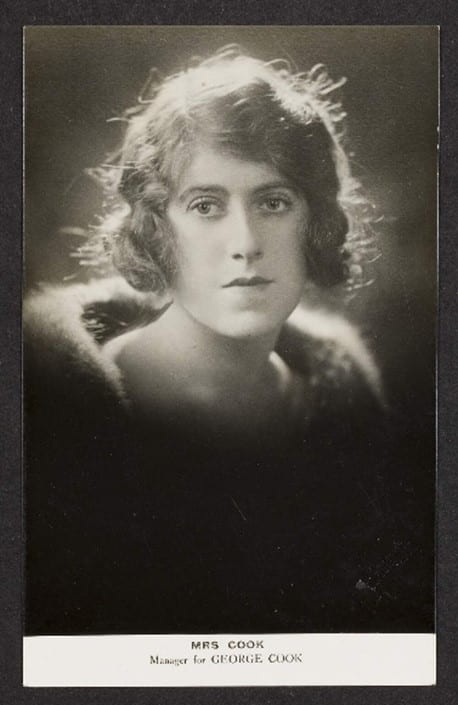
In this newly official capacity Emily continued to promote George as a challenger to rising international stars with occasional returns to Australia. By his 400th fight the 38-year-old George was considered an old man for a boxer, and his staying power in the face of ever-younger opponents became part of his popular appeal. The partnership was evidently a close one, and Emily’s decisions had real weight. After Emily was hospitalised for a serious illness, she reported that “no one could do anything with George, We had never been separated in 15 years of marriage… he used to come down to the hospital at four o’clock in the morning to bring me letters he had written to me during the night”. After a knockout loss in 1936 Emily insisted on George’s retirement, but after two years he secured her agreement to a last fight to mark his 25th year of boxing. In somewhat classic fashion this final match was a loss (apparently after George failed to hear the bell ending a round) but his performance against a man sixteen years his junior was lauded for endurance and grit.

George Cook’s longevity as a fighter (overlapping what was considered three generations of boxers) was credited to his wife and manager’s support, alongside a notably strict fitness regime. Much was made in the press about his gymnasium (at which young Julia could often be seen) and devotion to ‘the art of physical culture’. As George’s boxing career entered its twilight, the couple took advantage of George’s reputation and the prevailing fashion for athleticism by opening a ‘physical culture school’ catering for the well-to-do denizens of Belgravia, complete with a residential annex for “business-men who want to keep fit”. Accounts of the family’s settled life in London suggest a busy and prosperous existence, with Emily described as owning a hat-shop and a list of George’s properties including a public house, a snack bar, and a café. With the outbreak of the War, the 18-year-old Julia joined the Red Cross as a nurse while George devoted himself to volunteer fire-fighting during London’s Blitz. At the age of 45, George Cook passed away after ‘a short illness’. His death elicited heartfelt commemoration in the Australian and British press about an “evergreen” boxer who “never quite succeeded” but whose gameness and tenacity marked him out as an example. The sporting obituaries made little reference to Emily (especially compared to his other managers), despite what George readily described as her crucial role in his career.
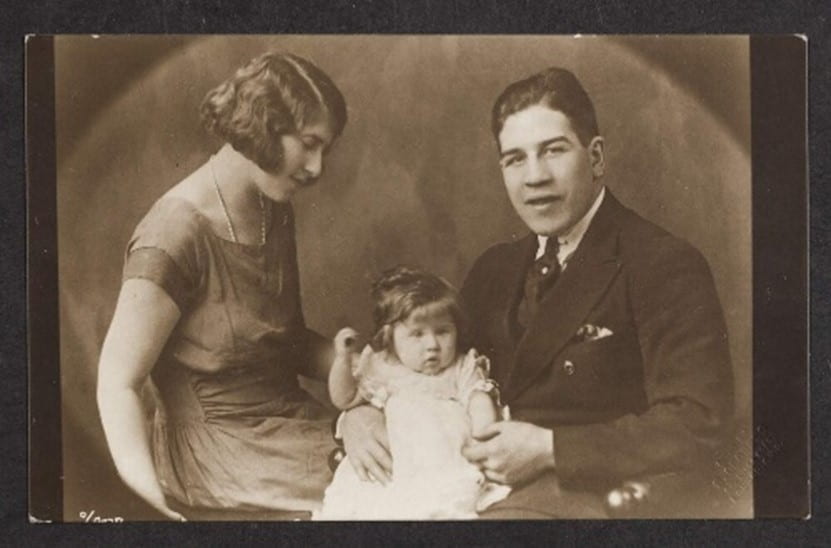
George Cook fought his way from extremely humble origins in Wiradjuri Country and found freedom and joy in the Empire’s Metropole. The war-widow Emily was crucial to the unorthodox success of George’s career, but the full scale of her role was often overshadowed by how it was reported. The adult journey of Julia the ‘well-travelled child’ passes from view with her father’s obituary. In addition to the visual echoes of a remarkable set of lives, the Cook family’s photos in the UMA present an intriguing set of threads for further investigation.
George Fforde is a PhD candidate in the School of Historical and Philosophical Studies undertaking research on the KGB’s role in forced psychiatric treatment of Soviet dissenters.
References
“Big Changes at Sydney Stadium.” The Daily Telegraph (Sydney, NSW), March 15 1932. Trove. https://trove.nla.gov.au/newspaper/article/246543496.
“Boxer as Fire-Fighter – George Cook In London.” Kalgoorlie Miner (WA), January 16, 1941. Trove. https://trove.nla.gov.au/newspaper/article/95062389.
“Boxer Weds.” Chronicle (Adelaide, SA), July 1 1922. Trove. https://trove.nla.gov.au/newspaper/page/8603676
“Boxer’s Daughter.” The Sun (Sydney, NSW), February 13, 1931. Trove. https://trove.nla.gov.au/newspaper/article/224672764
“Boxing – Overweight Gloves: Carnera’s Offer.” Examiner (Launceston, Tas.), March 10, 1932. Trove. https://trove.nla.gov.au/newspaper/page/3291176
“By The Way – Much Travelled Child.” Smith’s Weekly (NSW), November 23, 1929. Trove. https://trove.nla.gov.au/newspaper/article/234412253
“Cook’s Wife His Boxing Manager: Discloses Offer By Carnera To Use Heavy Gloves.” The Advertiser (Adelaide, SA), March 10 1932. Trove. https://trove.nla.gov.au/newspaper/article/46845229
“Effect Of Marriage On Athletes.” Maryborough Chronicle, Wide Bay, and Burnett Advertiser (Queensland), October 19, 1937. Trove. https://trove.nla.gov.au/newspaper/article/151216671
“First Woman To Be Boxer-Manager – Mrs George Cook Plans Matches.” The Herald (Melbourne, Vic.), December 19, 1933. Trove. https://trove.nla.gov.au/newspaper/article/243218526/26385407
“George Cook Dead.” The Sun (Sydney, NSW), October 9, 1943. Trove. https://trove.nla.gov.au/newspaper/article/231605595?
“George Cook, Fire-Fighter.” The Argus (Melbourne, Vic.), January 15, 1941. Trove. https://trove.nla.gov.au/newspaper/article/8158557/610727
“George Cook. Greatly Improved Boxer.” The Register (Adelaide, SA), April 23, 1923. Trove. https://trove.nla.gov.au/newspaper/article/64186534
“George Cook Weds – Famous Boxer And A London Widow.” Sunday Illustrated (London, UK), April 23, 1922. British Newspaper Archive. https://www.britishnewspaperarchive.co.uk/viewer/bl/0003277/19220423/047/0004
“Let Me Fight – Cook’s Plea To Wife – Veteran Australian’s Ambition.” The Armidale Express and New England Daily Advertiser (NSW), July 13, 1936. Trove. https://trove.nla.gov.au/newspaper/article/192706019
“Memories of Evergreen Boxer, George Cook.” Sporting Globe (Melbourne, Vic.), April 12, 1947. Trove. https://trove.nla.gov.au/newspaper/article/178134038
Miller, W. H. “He Was The Gamest Fighter – The Golden Age Of Boxing.” Good Morning (London, UK), November 26, 1943. The British Newspaper Archive. https://www.britishnewspaperarchive.co.uk/viewer/bl/0002312/19431126/006/0001
“Mrs. George Cook.” Warwick Daily News (Qld.), December 20, 1933. Trove. https://trove.nla.gov.au/newspaper/article/177373718
“Our Letter From London… George Cook And Physical Culture.” Queensland Times (Qld.), May 28, 1938. Trove. https://trove.nla.gov.au/newspaper/article/115610960
“Veteran Boxer, George Cook, Passes.” Sporting Globe (Melbourne, Vic.), October 9, 1943. Trove. https://trove.nla.gov.au/newspaper/article/181669611
“West Melbourne Stadium. Cook Scores K.O.” Referee (Sydney, NSW), April 1, 1931. https://trove.nla.gov.au/newspaper/article/136749322
“The Wedding Ring. Boxer Cook’s Marriage.” The Journal (Adelaide, SA), April 19 1922. Trove. https://trove.nla.gov.au/newspaper/article/200913421
“Women In Boxing: Mrs. Cook Seeks A Licence.” The Daily News (Perth, WA), July 3, 1933. Trove. https://trove.nla.gov.au/newspaper/article/85006997
“Wife In Corner: George Cook’s Advisor.” Newcastle Morning Herald and Miner’s Advocate (NSW), March 10, 1932. Trove. https://trove.nla.gov.au/newspaper/article/136888995